SEPTEMBER 18TH, 2024, FEATURE INTERVIEW WITH AWARD-WINNING NONFICTION MG & PB CHILDREN’S BOOK AUTHOR MEGAN CLENDENAN, CONDUCTED BY KIDLIT WRITE, BLOGGER & FORMER LIBRARIAN CHELSEA DICICCO

Today, I’m talking with children’s book writer and environmentalist Megan Clendenan. We’ll be chatting about non-fiction in middle grade and how to get kids inspired to think about the world around them. We’ll also be sharing writing tips, free educator resources, and of course- giveaway prizes! So be sure to stick around to the end (or scroll to the bottom of the interview and drop a comment to enter the giveaway pool- extra entries for shares/retweets & tags!)

But before we jump into our interview, if this is your first time visiting the blog, here’s the scoop on Feature Interviews.

THE SCOOP: WHAT ARE FEATURE INTERVIEWS & WHO ARE THEY FOR?

Feature Interviews are a free resource for writers and illustrators at every stage of the publishing journey.

Every month, I collaborate with industry professionals—authors, illustrators, editors, and agents— many of whom were or currently are also educators and librarians, to discuss all things publishing.

What can these interviews offer YOU?

These interviews give readers an up-close and personal look at the world of publishing from an array of different perspectives on every side of the desk and offer insight into tips, resources, and advice on how to:

  • stay current with market trends
  • hook an agent or editor
  • find writing community & other resources
  • discover workshops, contests, and other events
  • figure out which path of publication is right for you
  • know if your agent is a good match

And more!

AND… if that’s not enough, every guest offers at least one giveaway prize—sometimes more. This means you have multiple opportunities to win prizes every month! *If you’re interested in entering the giveaway, scroll to the bottom of the interview for instructions.*

Not that we’ve shared a little about what’s in store… it’s time to jump into our interview!

INTERVIEW QUESTIONS & TOPICS OF DISCUSSION:

  • BEGINNINGS & INSPIRATIONS: WHY, HOW, WHEN?
  • ROUTES TO PUBLISHING: TO QUERY OR NOT TO QUERY?
  • TIPS & RESOURCES
  • TIMEFRAMES & EXPECTATIONS
  • MOTIVATIONS AND HEART
  • EMPATHY, AWARENESS, DIVERSITY
  • BOOKS
  • GIVEAWAY
  • AUTHOR BIO & CONNECT

“My kidlit journey began when my son was a newborn (he is now 14!) I wrote during his nap times, scribbling away on paper as fast as I could. Years later – those scribblings turned into my first published book, OFFBEAT…” @MeganClendenan

Megan, it’s wonderful to have you on the blog with us today. And it’s wild to think we’re already this far into the year. Where does the time go? I’ve had a chance to peruse your website (which is adorable, by the way- I love your header and color palette). While I was perusing, I saw that your book, Cities: How Humans Live Together, was chosen as a Librarian Favorite for 2024. Very cool! Congratulations. But before I head down the road of your accolades, I’d love to hear how you wound up in the kidlit publishing arena. How’d you get here? And where/when did that journey start?

Thank you so much for having me on your blog! I enjoy reading your feature interviews, and I always learn something new.

-Aw, that makes me so glad to hear!

My kidlit journey began when my son was a newborn (he is now 14!). I’d always written short stories and poems, but as a new mom at home, I decided I would try writing a novel, something I’d always wanted to do. I wrote during his nap times, scribbling away on paper as fast as I could. Years later – about eight, I believe – those scribblings turned into my first published book, OFFBEAT, a middle-grade novel for reluctant readers. While that was fiction, most of my kidlit writing is non-fiction (more on that below!).

Prior to your author days, what line of work were you in (or are you currently in, outside of writing)?

For many years, I worked full-time as a communications and fund development writer for non-profit groups that focused on social and environmental issues. My job was to create written materials that would raise awareness and inspire people to donate money. For example, I worked for an environmental law organization that took governments and companies to task for pollution, and I worked for a social service organization that helped to advocate for women’s rights, access to healthy food in urban areas, and affordable housing. Later, I moved from full-time to part-time and then contract as I became more and more involved in writing for kidlit.

-How fascinating! I love hearing about your history with nonprofits.

Now for the why. I love asking this question separately because I feel like it’s the most important part of it all, and so it deserves a space of its own. What is your big WHY? Why do you write the stories you write; what do they mean to YOU? And why do you want to share them with others; what do you hope they will mean to THEM?


This is such a great question! I think my ‘big why’ can be summarized into one word – curiosity! Writing non-fiction means that I get to constantly learn about new topics. I choose subjects that I’m curious and intrigued by and that I think middle-grade readers will also find interesting but that they may not have been exposed to. Although I’ve written about topics that can feel large and challenging to consider, such as climate change, food security, or human rights, I always try to leave readers with the hopeful message that small actions can go a long way and that change is possible. I hope my books spark questions, discussion, and curiosity about the world and how we can work together to find sustainable and equitable solutions for the future. I enjoy writing for middle-grade readers because I love how full of wonder and curiosity they are, with great questions and an openness to learning about the world.

-I love this!

“…My big why can be summarized into one word – curiosity! Writing NF means I get to constantly learn about new topics. I choose subjects I’m curious & intrigued by & that I think middle-grade readers will also find interesting but may not have been exposed to.” @MeganClendenan

“I hope my books spark questions, discussion, and curiosity about the world and how we can work together to find sustainable and equitable solutions for the future. I enjoy writing for middle-grade readers because I love how full of wonder and curiosity they are, with great questions and an openness to learning about the world.”

I saw in your bio that you’re a freelance writer. Could you share a little about what freelance writing in publishing entails? And how might someone go about pursuing this as a career? How does freelance writing differ from traditional publishing? Explain. (Payments/contracts/timeframes, etc.)

I’ve pursued a few different avenues of freelance writing, some in publishing, some not. When I first started taking writing contracts, which is essentially what freelance writing means, I had just left my part-time role as a communications writer for a non-profit. The administration at the non-profit was very supportive, and they not only offered me some of my first contracts but they also recommended me to their contacts – and that’s how I got my first set of clients. 

-Wow, that's so interesting!

I did ghostwriting for executives, mostly women, as well as wrote grant applications, website copy, and other business materials, to name a few things. Topics ranged from children’s psychology to engineering technology! Other clients came from word of mouth. In terms of pay, I charge an hourly fee, and I invoice my clients upon completion of the work.
 
But I still wanted to pursue my dream of working in kidlit. I was working on my novel, but I also put together a work-for-hire ‘package’, which was essentially my resume, my interests/area of knowledge, and a few writing samples that I created specifically for the K-12 market. After sending out A LOT of packages (I can’t remember how many, but lots!) and waiting more than six months, I was offered my first work-for-hire contract! Since then, I’ve worked for a few different publishers on a range of assignments, for example, reading comprehension passages, biographical stories, a non-fiction book for reluctant readers.
 
Work-for-hire in the publishing world is not a high-paid endeavor, especially compared to the contracts I do for non-profits and businesses. In my experience, I was hired to write a specific idea determined by the publisher on a flat-rate basis, half when I signed the contract and the remainder upon completion of the work. And they often have very tight timelines. But I love writing kidlit, and if you work efficiently and find opportunities that you think are fair, it can be a great way to earn some money.

“Work-for-hire in the publishing world is not a high-paid endeavor… In my experience, I was hired to write a specific idea determined by the publisher on a flat-rate basis, half when I signed the contract and the remainder upon completion of the work… And they often have very tight timelines.”

Do you have any suggestions, tips, or resources you’d like to offer writers who may be interested in looking into freelance writing?

My advice to someone who would like to pursue freelance writing would be to consider their own networks and experience. Is there a niche area where they could offer expertise as a freelance writer? If so, is there a contact they could approach? What I found was that once I had some contracts completed, people began to refer me to others, especially when I let them know I was looking for additional work.

In terms of breaking into the kidlit work-for-hire space, I recommend putting the effort in to create a quality package of writing samples. They request ‘unedited’ samples, so it can’t be work that you’ve already had published, so it does take time to research and write the samples, even though they aren’t long (I did 2-3 pages for middle-grade and about 500 words aimed at a younger audience). Specific resources that I found useful include:

Evelyn Christensen has created an amazing list of potential work-for-hire markets on her website as well as a great list of tips:
http://www.evelynchristensen.com/markets.html
http://evelynchristensen.com/markettips.html

I also highly recommend Laura Purdie Salas’ book Writing for the Educational Market for guidance in creating a packet to send to work-for-hire publishers.
Do you write freelance writing across genres- if so, which genres do you write in? And what are some of the topics you write about?
I have written in a wide variety of genres! Some of the topics I’ve written about are sustainability/environmentalism, biography, and outdoor adventure.

“My advice to someone who would like to pursue freelance writing would be to consider their own networks and experience. Is there a niche area where they could offer expertise as a freelance writer? If so, is there a contact they could approach? I found that once I had some contracts completed, people began to refer me to others, especially when I let them know I was looking for additional work.”

In terms of breaking into the kidlit work-for-hire space, I recommend putting the effort in to create a quality package of writing samples. They request ‘unedited’ samples, so it can’t be work that you’ve already had published, so it does take time to research and write the samples, even though they aren’t long (I did 2-3 pages for middle-grade and about 500 words aimed at a younger audience). Specific resources that I found useful include:

Evelyn Christensen has created an amazing list of potential work-for-hire markets on her website as well as a great list of tips:

http://www.evelynchristensen.com/markets.html
http://evelynchristensen.com/markettips.html

I also highly recommend Laura Purdie Salas’ book Writing for the Educational Market for guidance in creating a packet to send to work-for-hire publishers.

- Thanks so much for sharing this information with us, Megan! These are terrific resources.

Do you write freelance writing across genres- if so, which genres do you write in? And what are some of the topics you write about?

I have written in a wide variety of genres! Some of the topics I’ve written about are sustainability/environmentalism, biography, and outdoor adventure.

So, you write non-fiction, which is so exciting because I love learning new things. Can you tell us a little bit about what it’s like writing non-fiction middle-grade novels as well as picture books and how that might differ from writing or pitching fiction?

I also love learning new things! When pitching fiction for the trade market, either with your agent or direct to publishers you need to have the full manuscript ready to go. Middle-grade non-fiction is different as it is usually sold on proposal rather than on the full manuscript. My process is to start with research and see if I can come up with a hook, structure, and a basic table of contents. If I decide I’d like to go ahead with the idea, I do more research, potentially interview an expert, and fully develop my outline. Then, I usually write at least one sample chapter. All those components will be part of the proposal that will go on submission to editors, alongside market information, curriculum tie-ins, etc. If an editor acquires the book, that’s when I would research and write the full manuscript. For picture book non-fiction, I write the full manuscript (and usually back matter as well), and that’s what goes on submission.

Now, you’ve worked on freelance projects, but you’ve also published multiple middle-grade non-fiction novels and just recently had the announcement of your debut picture book (congratulations!) that’s scheduled to come out in 2025. I’m curious: for your published middle-grade and picture book, did you have literary representation? If so, who were you represented by, and how did you end up with your agent?

Great question! For my first two middle-grade non-fiction books, I did not have an agent. Instead, I pitched my ideas directly to editors myself. In 2021, I signed with an agent. Since then, all my books have been sold through my agent.

I’m represented by Stacey Kondla at The Rights Factory. In 2021, I queried a number of agents, and right from the start, Stacey was excited about my work, and I ended up signing with her that summer.

-OH MY GOODNESS- CONGRATULATIONS!! This is HUGE news and definitely cause for celebration!

For those deciding which publishing route to take- agent, or no agent- traditional, or independent- could you talk a little bit about the differences between both and reasons why someone might choose one option over the other and vice versa?

Working with an agent is helpful for a number of reasons. They are familiar with the market, they build relationships with editors, and they can help you bring your work to the next level – important in such a competitive marketplace, and there are limited publishers that accept submissions directly from authors, so agents definitely open doors for authors in terms of access. That being said, there are publishers that accept submissions directly from authors, so some writers might want to go that route. I think it's a personal choice!

For some of our readers who may be new to the publishing scene, could you share a little bit about the steps involved with your publishing journey? (Querying & submission process, timeframes, rejections, champagne rejections, the close calls, the big call, and the final YES)

For sure! It’s definitely a long journey and can feel even longer because there is a lot of waiting involved. When I queried agents, I sent out about 15-20 queries in my first round. My agent was in that first round, and so for me, the querying process was relatively quick. After she got in touch and said she liked my work, we had ‘the call,’ and she offered representation. Yay! Then we got to work putting together a project for submission to editors. Querying editors also takes time and waiting for responses can take weeks to months to even longer! For my upcoming non-fiction picture book, I believe it took around six - seven months from the day we went on submission to an offer, and from what I’ve heard, that’s actually quite a fast timeline! However, not all manuscripts that go on submission sell, and that’s true for all the writers I know. Last year I had a project that I loved, and it did a number of rounds of submission to editors. While I received some nice feedback about the writing, ultimately, it did not sell to anyone, and I’ve had to put that one in the back of the drawer – at least for now!

“[Publishing] is definitely a long journey and can feel even longer because there’s a lot of waiting involved… Querying editors also takes time and waiting for responses can take weeks to months to even longer!” @MeganClendenan

“Working with an agent is helpful for a number of reasons. They are familiar with the market, they build relationships with editors, and they can help you bring your work to the next level, which is important in such a competitive marketplace…”

“So much of what happens in publishing can’t be controlled. You can’t control what editors want or what the market is doing, supply chains, book bans, or what types of books are selling. You can’t control how long it takes a book to be published or variables like printing costs, etc. I try to keep myself focused on what I can control– which is creating quality work!”

What are some of the hurdles that may present themselves on the road to publishing?

So much of what happens in publishing cannot be controlled. You can’t control what editors want or what the market is doing, supply chains, book bans, or what types of books are selling. You can’t control how long it takes a book to be published or variables like printing costs, etc. I try to keep myself focused on what I can control, which is creating quality work!

What are some challenges you’ve faced, and how’ve you been able to overcome them?
Balancing writing with the rest of life can be tricky. Work-for-hire contracts are often on tight deadlines, and so other projects, especially those without contracts and deadlines, often get pushed to the background. And life can throw curve balls! Earlier this year, I was in a serious car accident and could only minimally work for three months. I managed to fulfill my current contracts (with some extended deadlines from editors!), but I couldn’t move forward with any new work, so I’ll have to catch up. It was frustrating, but to get myself back on track, I try to find one hour a day – or at least 30 minutes – to work on a writing project that pushes me creatively. I find this helps me stay inspired and move forward more productively with all the tasks I need to accomplish.
When dealing with publishing setbacks/discouragements/etc. what has helped/inspired you the most to stay on the course and continue?
Rejection and setbacks are part of being a children’s author – that being said, it can still sting. Every author I know puts so much effort and heart into their writing, myself included. I rely on my writing friends to help me weather rejections. We support each other through setbacks and meanwhile, I continue to develop new ideas, which keeps me focused on the present. I’m also inspired to write by reading. I read a wide variety of fiction and non-fiction, and many of my ideas have been sparked by reading. It’s pretty awesome that reading is a part of my job description!
For those who may be dealing with discouragements or difficulties, what words of advice or wisdom would you like to share?
Find a community of other kidlit writers! Being connected to other people who understand the industry and can offer support has been invaluable to me.
Here on the blog, we love sharing writing resources. I know you’ve participated in a number of groups. I’d love to hear more about some of the writing organizations you’ve worked with. (Inked Voices, 12x12, SCBWI) Could you share with our readers a little about what each organization has to offer and how it’s personally benefited you?

Absolutely! I am so grateful to all the writers' organizations I belong to; they each offer a little something different, and they have enhanced my writing and connected me to other writers. I’ve been a member of Inked Voices for many years, and it is a fabulous resource for finding critique partners and there are many other resources, such as monthly craft webinars and genre-specific community networking groups. I’ve found many wonderful critique partners on Inked Voices! I have joined 12x12 for the last two years, and it’s also an incredible resource for picture book writers. They have amazing monthly webinars and book chats, and I always take the time to watch those. For time reasons, I haven’t spent as much time using the resources available on 12x12, but there’s so much to benefit writers, and everyone in the community is very welcoming. I’m also a member of SCBWI and I have benefited from the many online resources and webinars they offer.

Speaking of AMAZING resources, you also offer resources on your website (which I’d love to link here for readers to find on my Teacher Corner tab also). Could you tell us about the resources you offer? Who are they for, and how can they be utilized?

I have free downloadable resources on my website for each of my books. They are educator guides meant to be used alongside the books to help inspire critical thinking about the topic. They could be used by teachers or parents, or older readers could use them independently if they choose. I try to create a range of discussion questions, writing exercises, and some interactive activities that might be useful in a number of subjects, for example, Language Arts, Social Studies, or Science. I’d love for you to link them here for readers. Thank you! The guide for What Do We Eat? is currently in the works and will be posted soon!

-Wonderful!

In writing, there are really no shortcuts- it requires a lot of effort, time, and commitment. But if you had a trick up your sleeve to share- what would it be?

I wish I had a trick up my sleeve, but in all honesty, I think the trick is to stay persistent and keep writing and revising.

Any final tips?
I’m going to repeat myself and say 1) don’t give up, and 2) find some writer friends to share the journey with.

-Thanks so much, Megan.

“…The trick is to stay persistent and keep writing and revising.”

“I am so grateful to all the writers’ organizations I belong to; they each offer a little something different, and they have enhanced my writing and connected me to other writers.” @MeganClendenan

We’ve finally made it to the land of books. I would love to hear all about your wonderful work! What was the inspiration behind it? How did the story begin (the story behind the story?) How long did it take to get from concept to manuscript to where you are now? Everything. Go! 

What Do We Eat? How Humans Find, Share and Grow Food
Releasing September 17th, 2024, from Orca Books

Summary; Imagine carrying meals with you as you parachute into a war zone. Or trying to stay well-fed while building the pyramids. People have always found ways to work together to put a meal on the table. What Do We Eat? is a delicious celebration of human creativity and cooperation, wrapped up in bite-sized slices of history, with a look at what scientists and inventors are cooking for the future. We are gobbling up Earth’s resources, and food is not shared equally. But today, there's a magic tree transforming the dry African plains, food “ambulances” on the move and cities that have declared access to food a human right. Hungry to find out more? Let’s roll up our sleeves and find out what’s for dinner.

Inspiration behind What Do We Eat?

During the Covid-19 pandemic, there were times when I went to my local grocery store and found empty shelves. I began to wonder: how difficult would it be to survive without going to the grocery store? That led me to more questions. How did people in difficult situations in history eat? What about people exploring the world? Escaping from injustices? Stranded far from home? How do people facing climate change adapt? This book is the result of all these wonderings (and a LOT of research!). From concept to publication was more than four years!

Cities: How Humans Live Together (Orca Books, 2023)

Summary: If you could design a city that would be both a great place to live and good for the planet, what would it look like? Today, about four billion people—more than half the world’s population—live in cities. This number could rise to seven billion by 2050. Cities: How Humans Live Together travels through time to explore questions like When and why did cities form? How did people access food and water? Where did they go to the bathroom? Peek into the past to see how cities have changed through time and explore what could make cities more sustainable and welcoming for today and tomorrow.

Inspiration behind Cities: How Humans Live Together

At university, I studied environmental urban planning, but I ended up on a different professional path. But, I remained curious and interested in cities and urban planning, and I wanted to write a book about cities around the world, past, present, and future. I loved researching cities for this book! This book was also about four years from concept to publication.

Fresh Air, Clean Water: Defending Our Right to a Healthy Environment (Orca Books, 2022) explores the connections between our environment and our health and why the right to live in a healthy environment should be protected as a human right. The book features profiles of kids around the world who are taking action and important environmental rights court cases. Hear the powerful stories of those fighting for change.

Inspiration behind Fresh Air, Clean Water

I was inspired to write this book after working as a grant writer at an environmental legal non-profit, where I worked to obtain funding for many cases, including about the right to a healthy environment. The idea that the right to fresh air and clean water could be fought for as a human right, just like the right to free speech, was such an exciting idea to me. Years later, I was inspired by youth-led climate lawsuits, and I was able to interview many youth activists, which was my favorite aspect of writing this book!

What do you hope your readers will take away from each story?

With all my books, I want to leave readers with a sense of hope and the possibility that change is possible, even when considering topics like climate change. That the power of human innovation, resourcefulness, and cooperation goes a long way. I hope my books spark questions, discussion, and curiosity.

Have you been able to host any fun author events? And what has the response been to your stories?

I love visiting schools, libraries, and festivals (it’s always exciting to be able to be there in person!) to share my books. One favorite author event was a two-part writing workshop I did with a group of high school students around the theme of Earth Day. Even though my books are aimed at a younger audience, it was wonderful to connect with high school students and get their perspective. I learned a lot by speaking with them!

As well, I’ve been fortunate that readers of Fresh Air, Clean Water have shared their thoughts as well as ‘climate march’ signs in response to the book (creating a climate march sign is one of the activities on my free Educator Guide for the book – found on my website). With these students’ permission, I put together a video to showcase their art and thoughts. You can find this on my website under Resources & Fun Stuff.

I also love connecting with schools virtually because it allows me to reach so many more locations! This fall, I’ve got some events planned around the release of What Do We Eat? and I’m so excited to finally share this book with readers.

-Very cool, Megan!

“I want to leave readers with a sense of hope and the possibility that change is possible… I hope my books spark questions, discussion, and curiosity.”

GIVEAWAY

For the month of September, Megan is offering the following giveaway prize to one winner.

Prize #1: A signed copy of WHAT DO WE EAT? How Humans Find, Grow and Share Food (middle-grade non-fiction)

HOW TO ENTER THE GIVEAWAY

  • Leave a comment on this post!
  • And if you haven’t already, like this post and subscribe to the blog and/or newsletter!

That’s it!

DEADLINE TO ENTER: September 30th, 11:59 PM CST

Want extra entries? Share this link and tag the host IG @chelseasworldofbooks X @chellysbooks to have another entry added to the prize pool.

FAQ:

What if I was already subscribed to the blog? Does that mean I won’t qualify for the Prize Giveaway? Not at all! If you subscribed before this month, all you’ll need to do is LIKE this Feature Interview and leave your COMMENT below this post within the deadline (the current month/year entry was posted).

Did you enjoy this interview?

Thank the author & host by purchasing a copy of one of their books or by requesting it be purchased at your local library! Using the sponsored links below supports this blog.

Book Links

Purchase Design Like Nature Biomimicry for a Healthy Planet

Purchase Fresh Air Clean Water

Purchase Cities How Humans Live Together

Megan Clendenan shares her experience with writing and publishing across non-fiction PB & MG and shares a look at the different options and routes to publication, including work-for-hire projects and writing for nonprofit groups, as well as landing literary representation and traditional publishing.

Purchase What Do We Eat?

Megan Clendenan is a freelance writer and award-winning children’s book author. She loves writing books that explore history, society, and the environment, and she hopes to inspire young readers to think critically about the world around them. Her books include DESIGN LIKE NATURE: BIOMIMICRY FOR A HEALTHY PLANET, which earned a starred review from School Library Journal (2021, Orca Books, co-authored with Kim Ryall Woolcock), FRESH AIR, CLEAN WATER: OUR RIGHT TO A HEALTHY ENVIRONMENT, which won the 2023 Green Earth Book Award (2022, Orca Books), CITIES: HOW HUMANS LIVE TOGETHER (2023, Orca Books), WHAT DO WE EAT: HOW HUMANS FIND, GROW AND SHARE FOOD (Orca Books, Sep 2024) and JUST IN CASE,[1]  a non-fiction picture book that will publish in September 2025 with Charlesbridge. To learn more and find free educator resources visit her at www.meganclendenan.com. Megan lives near Vancouver, British Columbia, with her family & two fuzzy orange cats.

Twitter: @MeganClendenan Instagram: @MeganClendenan

Looking for custom writer/library/book-lover-themed swag/accessories? Visit my Zazzle store! Want to see a curated list of my personal favorite books and recommendations? Visit my bookshop page! Want to browse favorite writing accessories, books by genre, and cozy reading must-haves? Visit my Amazon Storefront!

JANUARY 3RD, 2024, FEATURE INTERVIEW WITH CHILDREN’S BOOK AUTHOR DEBRA KEMPF SHUMAKER, CONDUCTED BY KIDLIT WRITER, BLOGGER & LIBRARIAN CHELSEA DICICCO

Hello, writing friends, and welcome back to Chelsea’s World of Books blog. Can you believe we’re in the new year ALREADY? And to get things started, we’re diving into 2024 with a very special guest; Children’s Book Author of one of our favorites, FREAKY, FUNKY FISH, Debra Shumaker!

But before we get started… just in case this is your first time here, let me tell you a little about what makes segments special.

WHAT’S SO GREAT ABOUT FEATURE INTERVIEWS?

Feature Interviews are an INVALUABLE resource for kidlit writers and illustrators at every stage of their publishing journey. Not only are they a great way to stay current on market trends and learn more about the industry’s ins and outs, but they also give readers an up close & personal look at the world of publication from the perspectives of a diverse collection of creators.

Every month, I sit down with members of the writing community (authors, illustrators, editors, and agents), and we discuss all things kidlit publishing.

Here are a few examples of topics:

  • Writing workshops and resources
  • Diversity in literature and why it matters
  • Where to find support and community
  • How to improve writing craft and set goals
  • How to deal with setbacks/disappointments and WAITING
  • Helpful tips and suggestions for aspiring authors and illustrators
  • Querying agents, contract negotiations, book deals, and time frames
  • And of course- NEW BOOKS!

So, now that you know what to expect… let’s get into our interview.

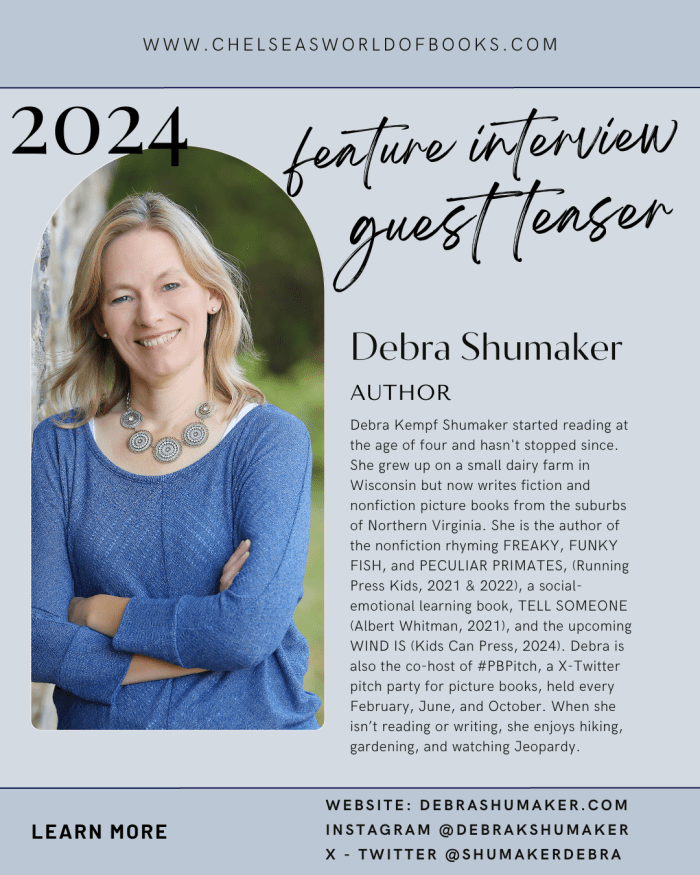
Debra Kempf Shumaker started reading at the age of four and hasn’t stopped since. She grew up on a small dairy farm in Wisconsin but now writes fiction and nonfiction picture books from the suburbs of Northern Virginia. She is the author of the nonfiction rhyming FREAKY, FUNKY FISH, and PECULIAR PRIMATES (Running Press Kids, 2021 & 2022), a social-emotional learning book, TELL SOMEONE (Albert Whitman, 2021), and the upcoming WIND IS (Kids Can Press, 2024). Debra is also the co-host of #PBPitch, a Twitter pitch party for picture books held every February, June, and October. When she isn’t reading or writing, she enjoys hiking, gardening, and watching Jeopardy. Visit her online at www.debrashumaker.com, on Twitter at @ShumakerDebra, and on Instagram at @debrakshumaker.

THE SPARK THAT STARTED IT ALL

Debra, I can’t tell you how thrilled I was to find your name among the many stuffed in my submissions box for the 2024 Feature Interview lineup. Being a librarian and kidlit writer myself, I’ve had and witnessed many delightful read-alouds of your stories. Something that I love about your writing style is how you blend education with fun- and, to top it all off, you incorporate rhyme! Which is something that I think only the real wizardly kidlit writers of the world can successfully tame. But before I go off on a tangent on your books (I promise we’ll circle back to it), I’d love to start our conversation today by asking how you landed in the world of children’s publishing. What was “the spark that started it all?”

First, thank you so much for your kind words! I love hearing that read-alouds with my books are delightful! As far as “the spark,” as many writers can relate, I’ve always loved reading and had the “some day” dream of writing a novel. When I married and had kids, I took a step back from my corporate job and became a stay-at-home Mom. I took the kids to the library several times a week, checking out dozens of picture books. And I was floored. I didn’t remember picture books like those when I was a kid. And I fell in love with picture books. I decided that I was going to figure out how to be a part of the picture book creation. My kids are in their upper teens and twenties now, so it took a while, but I figured it out!

Can you tell us a little bit about what kinds of stories you write and why you write them?

I write both fiction and nonfiction picture books. So far, I’ve had more success with my nonfiction books. But I write whatever strikes my fancy. Many ideas come from some random fact that I read about or some emotions I’m feeling—wonder, joy, fear, sadness, or a complicated mixture—and want to write a story to give a place for kids to either find that wonder or explore their complicated feelings, too. And sometimes, I write a story because an editor asked for a specific story.

I understand that you grew up on a small farm with eight siblings, and you’ve always loved reading. Can you tell us a little more about your childhood experiences with books and maybe share some of your favorites?

Growing up, as I did, we didn’t have a lot of money. But my Dad loved reading, so somehow, we always had books in our house, mostly from rummage sales or from people who knew we had a big family and wanted to pass down books from their family. I also loved Library Day and Scholastic Book Fairs. I don’t remember reading too many picture books, but I remember reading lots of easy readers. My favorite were Disney Encyclopedias. I spent hours and hours reading those!

I mentioned before that I’m a librarian… and I noticed on your website that your favorite day of each week as a young girl was “library day” at school. Which makes me so happy- mine was too! Can you tell us a little bit about the magic you experienced as a young girl in the library and what memories stand out most to you to this day?

As I mentioned, money was tight. Also, there were no bookstores nearby. I depended on Library Day during the school year and the Book Mobile (that we would bike to in the summer) to have new books to read. I remember the awe of walking up and down the bookshelves and picking as many as I could fit in my arms. I loved horses and probably read every horse book the library and Book Mobile had.


Now we’ve talked about the past… let’s fast-forward a little. Before becoming a children’s book author, what was life like? What kind of work did you do? And what were the events that led to the switch to writing as a career?

My first career out of college was as a Registered Dietitian for a nursing home. I eventually moved on to training healthcare software to staff in nursing homes, then staff development training for a healthcare software company. Not publishing-related at all. But sometimes, I took writing classes at community colleges because I dreamed of writing a novel someday. After having kids, becoming a stay-at-home Mom, and taking my boys to the library, the spark was ignited, as I noted in the first question. It took me a few years to call myself a writer, and a lot more years to finally get that byline in a magazine, and many more years before getting my name on a book!

THE PROCESS: QUERYING AGENTS/SUBMITTING TO PUBLISHING HOUSES

What was the publishing process like for you? Can you share a little about your experience with querying agents? When did you begin your publishing journey? When/how did you find your agent agent/agency match? 

The publishing process was very long. I started writing for kids in 2007, but with three boys in 3 ½ years, very sporadically. Once they started school, I started being more intentional in finding time to write. At first I wrote both picture books and magazine articles and did find success with a few articles in Boys’ Quest, Fun for Kidz, and Spider. By 2011, I had joined SCBWI and started seriously submitting picture books to editors then agents. Participating in challenges like PiBoIdMo (Picture Book Idea Month) and 12 x 12 greatly improved my writing and my understanding of publishing. Around 2015, I finally started getting champagne rejections and requests for R&Rs (revise and resubmits), but didn’t connect with an agent until 2017. That was Natascha Morris with BookEnds Literary. I submitted one of my fiction stories to her through the normal query process. She loved it and asked for a few more, then offered representation. (After she sold my first two books, she did leave BookEnds. I am now repped by James McGowan with BookEnds.)

Once you signed with your agent/agency, what was the submission process like?

The benefit to having an agent is to have the doors to bigger publishers open up. But having an agent also meant that every story I wrote did not necessarily go on sub. She had to feel confident in it, too. But I loved being able to put all my focus on my writing instead of researching agents or houses that took unsolicited subs.

How long did it take to receive your first book deal?

I first signed with Natascha in July of 2017. After a few revisions, she subbed that first story widely. I had several R&Rs, and it went to acquisitions to around 4 or 5 houses, but we never sold that book. It was 18 months and four other manuscript submissions later before we finally found an editor who gave me a YES. And that was for FREAKY, FUNKY FISH in January of 2019.

RESOURCES & WORDS OF ADVICE

The beginning stages of the writing journey is a very tender time. It’s a time for learning and growth. Like everything in life, real growth comes through patience and trial and error. And it can be difficult. Rejections sting. Waiting is hard. But, the further along you go, the stronger you get and the more you learn. What has been your biggest challenge in the kidlit publishing arena, and how have you been able to overcome it?

Rejection is hard. The one thing writers can’t control is agents or editors deciding to take on your book. One thing I could control was to continue to work on my craft and to continue to write and submit. I continually reminded myself that agents and editors were rejecting my stories, not me personally.

If you could share a piece of advice with newly aspiring authors or illustrators, what would it be?

I tell every aspiring picture book author to type up the text of picture books they love. (And that have been published in the last few years.) It’s the best way to get a feel for voice, pacing, page turns, and so much more. By doing this, it will become more innate when they write. Plus, if the book they are typing up has both an author and an illustrator, aspiring authors can get a better idea of how the manuscript looked when it was bought as a text-only document. Odds are, there was a lot of room left for the illustrator. I’ve typed up more than 300 books since 2015, and I continue to do so on a regular basis. My first drafts have improved so much because of this exercise.

Speaking of words of advice… let’s talk a little bit about writing community and resources. What are some of the best resources you were able to find when you started down the road to kidlit publishing?

In my first few years of writing, I didn’t know where to get ideas. I only had two manuscripts that I worked on over and over again. Thankfully, I stumbled upon Tara Lazar’s PiBoIdMo (Picture Book Idea Month) which has now morphed into StoryStorm that happens every January. It trained my brain to always be on alert for ideas, and now I have more than I can handle. Shortly after my first PiBoIdMo, I found Julie Hedlund’s 12x12. This was back when there weren’t agent submission opportunities and “levels”, just a community of writers attempting to write 12 picture book drafts in 12 months. Being a part of that community was priceless. The KidLit411 website is an amazing resource for KidLit writers.

Since we’re discussing helpful resources, I’d like to add the importance of having a strong writing community. Making connections is one of the best things a new writer or illustrator can do. Not only do you learn from each other… but you’re able to support and lift one another up. You can share and celebrate good news- and share and comfort hard news. It’s crucial for your mental health as a creator to have your clan of supporters around you- who both understand what it’s like and appreciate your continued efforts. Where are some places you’d recommend going to find that “kidlit community”?

Besides StoryStorm and 12x12, I love the KidLit411 Community on Facebook. Facebook has many great writing groups for community. But I also highly recommend finding a critique group, or two, or three, either in-person or online. I belong to four! The KidLit 411 website offers a place to find critique partners. And join SCBWI. When you join the national organization, you will get placed in a regional chapter. Conferences are an amazing way to meet fellow creators. Attending my regional conference is how I found my in-person critique group.

Another thing I think can really help to keep a creator’s creative juices flowing and inspired is participating in kidlit events. There are so many great contests out there! One of them is one that you co-host. Can you tell us a little bit about how you started #PBPitch events on Twitter/X, what they are, and what their intended purpose is?

Ah, #PBPitch. I’m so proud of it. It started back in 2015. I had just joined Twitter because in various KidLit groups on Facebook, I kept hearing about #PitMad, which was a pitch party for books for all ages. (For pitch parties, creators post a pitch for a completed manuscript with the corresponding hashtag, and if an agent or editor “hearts” it, it’s an invitation to submit the manuscript.) In March 2015, I participated in my first #PitMad, and there seemed to be very little love for picture books that day. Mandy Yates posted in one of the FB groups that someone should start one for just picture books. I responded that I had no idea what I was doing but would help. As did PJ McIlvaine. And before we knew it, the three of us created #PBPitch and hosted our first one a few months later. We had no idea if anyone would tweet or if any agent or editor would stop by, but they did! We’ve held it three times a year ever since. Each one has resulted in at least one successful agent match or book deal. We have numerous success stories on our website (pbpitch.weebly.com), and I’m sure many more have happened that we just aren’t aware of.

PREPPING FOR DEBUT AUTHOR BOOK LAUNCH: ORGANIZING VISITS/EVENTS: SCHOOLS, LIBRARIES, BOOK SIGNINGS

Okay, so now we have an agent, a book deal, and a launch date. Yay! Now what? Now it’s time to SELL the book. Can you tell us about your experience in preparing for your debut book launch and creating your author brand? What worked best? What didn’t? And why?

My debut, FREAKY, FUNKY FISH: ODD FACTS ABOUT FASCINATING FISH, came out in May 2021 when the world was still largely shut down due to the pandemic. I was able to have a launch outside of my local indie, Scrawl Books, but the weather was quite windy and chilly and sparsely attended. However, in getting ready for my debut, I joined a co-marketing group called PB Debut Troupe 21. Fourteen of us creators had debuts coming out that year, and we shared our joy, commiserated in the frustrations, helped boost each other’s books on social media, and wrote reviews. I’m still good friends with those creators. I highly recommend debuts join or create a co-marketing group!

A great way to boost your brand and share your story with others is by hosting author visits. Can you tell us about some of the visits you’ve hosted? How do you conduct your author visits? How long are they? Do you charge an author fee? Are you the one organizing them, or is it your agent/publisher? If you’re the one organizing, how do you go about reaching out about scheduling your visit?

Occasionally, a bookstore has reached out to my publisher for an author event, but that’s only been once or twice. So, 99% of the time, I am doing the outreach to bookstores, schools, and libraries. For readings at bookstores, I do not charge a fee, but for programs at libraries and schools, I do. For Author Visits at schools, I do 3 - 4 presentations in one day–I don’t only read my book and talk about being an author, I have presentations connected to curriculum. To promote my Author Visits, I’ve attended my state’s librarian conferences to connect with librarians. I’ve also sent out postcards to local schools. I did about six visits last year and loved them, and hope to do more!

What has been the response to the author visits? What has been your favorite part? What has been their favorite part?

My favorite part is being with the kids and exciting them about writing, reading, and science. Hearing them laugh about the facts in my book is priceless. And seeing their eyes light up because they are meeting a real, live author just warms my heart. Their favorite part is probably getting out of regular class, LOL. But I do think many of them love meeting someone who wrote the words in a book they read or heard.
Fox Mill Elementary School in Herndon, VA.
Marumsco Elementary in Woodbridge, VA. 

THE BOOKS! RHYME, EDUCATION & HEART

Okay, I promised we’d circle back- and here we are. We’ve finally arrived at my favorite part of the interview- THE BOOKS! 

As I mentioned earlier, I’m a big fan of your stories. I love learning, and your books FREAKY, FUNKY FISH, and PECULIAR PRIMATES are such inventive ways to spread knowledge. And your story TELL SOMEONE is just beautiful. But, enough about how much I love your work. I’d love to hear from YOU about each of your books. We touched on the types of books you write and why briefly earlier, but now I want to dig a little deeper. How did each of your stories come to be? What was the inspiration behind them? And what do you hope each story will give your reader?

For my debut, FREAKY, FUNKY FISH, I have to thank my first agent. I had been writing picture book biographies that just weren’t selling. She encouraged me to try something different. Since I love all nonfiction, I decided to try my hand at a science-y picture book and read some rhyming ones about bugs, water, squirrels, etc. I challenged myself to write one about a different animal. I recalled some research I had done about fish for a different fiction manuscript I wrote and remembered how strange some fish were. And wa-la, an idea was born.

For TELL SOMEONE, an editor asked my first agent if she had a writer who would like to try writing a story encouraging kids to talk about their feelings since Albert Whitman wanted to have one on their list. Natascha asked me. My gut reaction was “No,” as I had never written anything “on assignment,” but I pushed myself out of my comfort zone and said I would try. A few months later, I had a contract.

After we were in the final stages of FREAKY, FUNKY FISH, I decided to write a companion book about birds, which I titled BIZARRE BIRDS. Running Press Kids felt there were too many picture books about birds and asked if I’d be interested in writing one about primates, so I did!


For my science books, I hope kids are fascinated by the diversity of our world and are inspired to do what they can to preserve it. For TELL SOMEONE, I hope kids are encouraged to talk about their feelings in both good times and hard times. Mental health is important.

There’s a fun musicality that you use in your writing that truly puts the “fun” into “fun facts,” and at the same time, it’s funny. Heart, humor, and education are my favorite combination. And, somehow, you managed to add RHYME into the mix?! Possibly proving that you’re a magician? (Are you a magician?) Can you tell us what inspired you to write your stories in rhyme and what that process looked/felt like?

I love rhyme. My first publication ever was a rhyming poem about a snail who ate a nail in my 3rd-grade newsletter. I frequently wrote “odes” for various occasions growing up, for fun, so I think my debut was destined to rhyme, LOL. When I started writing picture books, I wrote several fiction/concept stories that rhymed but never sold. Some books seem to work better in rhyme, and for both the fish and primates books, I felt rhyme gave them another hook vs. just a list of strange animal adaptations. It’s a lot of work but so much fun, like setting a puzzle.

Did you have anyone try to discourage you from writing in rhyme- and if so, how did you respond?

No, no one discouraged me. I understand meter and know that rhyme is more than just counting syllables and using rhyming words at the end of two lines, so as I revise, I know the rhyme will read smoothly. I won’t quit until it does.

Okay, we’ve talked about rhyme. Now, let’s talk about illustration. Can you tell us about how you ended up with your illustrators and what your first thoughts were?

For Freaky Funky Fish & Peculiar Primates- Claire Powell
Tell Someone- Tristan Yuvienco


For both publishers, as is typical in traditional publishing, Running Press Kids and Albert Whitman found the illustrators. For Albert Whitman, the editor and art director, paired my text with Tristan’s art for the pitch at the acquisitions meeting, which was different from Running Press Kids. With them, FREAKY, FUNKY FISH was acquired first, then it took over ten months for them to find an illustrator.

I was absolutely thrilled with both Claire and Tristan once they were selected. Their portfolios were amazing.


Did you envision your characters and stories in a similar way to how they were illustrated?

For FREAKY, FUNKY FISH, I really didn’t have any vision in my head as I had seen so many photos of the fish as I was researching and writing it that I didn’t really give a thought to how they would look illustrated. But seeing Claire’s sketches for the first time was amazing—I loved the personalities she gave all the various fish!

For TELL SOMEONE, I hoped the art would depict various and diverse kids in the different scenarios, so Tristan’s art was in line with what I envisioned. But I was still amazed. His art is so sweet, I want to hug each child in that book.

Do you have a favorite spread from each book?

While I love so much about the illustrations in all three books, my favorite spread in FREAKY, FUNKY FISH is the one with the hammerhead shark and parrotfish. I love Claire’s colors and humor.

For PECULIAR PRIMATES, I love the nighttime scenes–the various primates are so adorable and huggable in that spread!

For TELL SOMEONE, my favorite page is the girl on the first day of school. Tristan’s perspective on this page really emphasizes the girl’s nervousness.
And… you have a new book coming out this Fall. Can you tell us a little bit about that one?

Yes, I do, and I’m so excited about it! WIND IS A DANCE, illustrated by the fabulous Josée Bisaillon, comes out with Kids Can Press on October 1, 2024. This book is a lyrical ode to the wind. I use metaphors to describe various winds we experience—from a ruffling, fluffing breeze to a rumbling, tumbling derecho. I’ve recently seen the colored sketches, and Josée’s art is SO stunning. I cannot wait for the world to see it!

If you could send your past self any piece of writerly advice, what would it be?

Be prepared for the long haul. Getting published is so, so hard, but absolutely worth it.

What’s one last message/piece of advice you’d like to impart to your readers?

If you are a writer and you want to be published, don’t give up. It may take more than 10 years, like it did for me. Work hard on craft and write new stories. Every manuscript you write will likely not get published. I wrote dozens of first drafts and about fifteen polished picture books before my first one was acquired. But I learned something from each manuscript I wrote, not one was a wasted effort.

Thanks so much for joining us today, Debra.

But we’re not quite finished. There’s still one last item on the agenda. And that is… the GIVEAWAY!

GIVEAWAY

Debra Shumaker is offering the following giveaway prize.

“A signed copy of one of my three books!”

HOW TO ENTER THE GIVEAWAY

During the month of January 2024:

  1. Subscribe to the blog
  2. Like this blog post
  3. Leave a comment below letting me know you’ve done 1-2. (If the guest is offering more than one prize, please specify which you’d like in the comments below.)

And that’s it!

FAQ: What if I was already subscribed to the blog? Does that mean I won’t qualify for the Prize Giveaway? Not at all! If you subscribed PRIOR to this month, all you’ll need to do is LIKE this Feature Interview and leave your comment below this post.

Wind is a Dance (not yet available for pre-order)

Connect with Debra Shumaker

Visit her website: www.debrashumaker.com

Visit her Twitter/X: @ShumakerDebra

Visit her Instagram: @debrakshumaker

Visit her Bluesky: @debrakshumaker

DECEMBER 2023 FEATURE INTERVIEW WITH COPYWRITER AND CHILDREN’S BOOK AUTHOR HOWARD PEARLSTEIN, CONDUCTED BY KIDLIT WRITER, BLOGGER & LIBRARIAN CHELSEA DICICCO

Hello, and welcome back to Chelsea’s World of Books blog. It’s time for another Feature Interview. If this is your first time visiting, let me tell you a little about what makes these segments so valuable.

WHAT’S SO GREAT ABOUT FEATURE INTERVIEWS?

Feature Interviews are an INVALUABLE resource for writers and illustrators at every stage of their publishing journey. Not only are they a great way to stay current on market trends and learn more about the industry’s ins and outs, but they also give readers an up close & personal look at the world of publication from the perspectives of a diverse collection of creators.

Every month, I sit down with members of the writing community, and we discuss everything publishing.

Here are some of the things we talk about:

  • Writing workshops and resources
  • Diversity in literature and why it matters
  • Where to find support and community
  • How to improve writing craft and set goals
  • How to deal with setbacks/disappointments and WAITING
  • Helpful tips and suggestions for aspiring authors and illustrators
  • Querying agents, contract negotiations, book deals, and time frames
  • And of course- NEW BOOKS!

So, now that you know what to expect… let’s get into our interview.

Author Bio

Howard Pearlstein is the author of nine picture books that have been translated into five languages. His upcoming titles in 2024 and 2025 include This Book Is Not For You and The Bad Book for Good Kids, both published by Familius. Howard is also the founder of Copy Rocket, an advertising copywriting agency, and has worked on some of the world’s most popular brands, including Toyota, Verizon and Mitsubishi. A California native, Howard now lives in Birmingham, Alabama with his wife, Debi. Howard has three daughters, Amanda, Jacquie and Emily, who live across the country, and one dog, Maeby, who still lives at home.

bEGINNING

I love starting these interviews by asking my guests how they ended up in the wonderful world of kidlit. Can you tell us how you arrived here?

How I ended up in the world of kidlit is a much longer story than we have time for today. But I can say that in 2018, I went through a period of self-reflection. Up until that point, my entire career had been in advertising. I loved the career and was proud of the work I had created. But, as I looked back, I realized that I hadn’t created anything for myself, anything personal. Since advertising really is telling a story with an interplay of pictures of words, I had a revelation that I should be able to write picture books. Of course, I had no idea what I was doing, so the first thing I did was Google “How to write picture books.”

And you’re the founder of a copywriting advertising agency. Can you tell us how that lends a role in your writing career?

I’ve been a copywriter since graduating from college and I truly believe that my advertising experience has provided the perfect training for writing picture books. In many ways, the process is similar:

-	You have to come up with a concept on how you will communicate an idea.
-	You have to understand who your target audience is and what motivates them.
-	You need to know what goals you’re trying to achieve.
-	You then need to create words and visuals that go together to tell the story in the most creative way possible.
-	You also need to use the fewest words possible to get across your message.
-	You want the final product to be something that speaks to the audience on an emotional level since that’s what sells.

PUBLICATION ROUTE: QUERYING & SUBMISSIONS/ AGENTS & PUBLISHING HOUSES

Can you tell us a little bit about your publication route. When did you first start querying agents/submitting to publishing houses?

After deciding to write picture books in 2018, I began querying my first manuscript, Orange Porange, in 2019. 

Were you agented for your first book deals? If not, can you explain what the submission process was like when sending manuscripts directly to publishing houses? And share some details on the timeframe that it took for you to land your first publishing book deal?

I began the submission process without an agent. In fact, I just signed with an agent last month (finally), Jes Trudel with The Rights Factory. Without an agent, the submission process is extremely tedious. First, you have to find which publishers accept unsolicited manuscripts. Then you have to research each publisher individually to see if their list aligns with your story. Then, you have to put together a query letter. Since I was so new to publishing, I again had to turn to Google and ask, “How do you get a picture book published.” Luckily, there’s a wealth of great information available. 
With Orange Porange, I started querying in July of 2019 and was lucky enough to find a home for it in August with Marshall-Cavendish.

Now I understand you recently got some very exciting news. Would you like to share this with us?

I touched on it earlier, but I finally have an agent! I had queried Jes Trudel with The Rights Factory with a new manuscript, and, on her Query Manager page, she allowed authors to submit additional manuscripts. I took advantage of that and was definitely excited when she reached out to me and wanted to talk. We had a great Zoom call, and I signed with her about a week later.
 I do hope everyone keeps in mind that I’ve been querying agents relentlessly for 5 years. In fact, one agency told me to stop querying them altogether. Querying publishers and agents is not an easy process.

CHALLENGES, ROADBLOCKS & INSPIRATION

What are some difficulties you’ve personally faced throughout your publication journey and what helped you to overcome them?

Constant rejection is by far the biggest difficulty. You receive one form rejection letter after another – or nothing at all. For me, what helped to overcome this difficulty was always keeping my commitment to my goal (to be a picture book author) front and center at all times. Challenges, obstacles, and difficulties don’t matter when you’re 100% dedicated to your destination.

I love that! "Challenges, obstacles, and difficulties don't matter when you're 100% DEDICATED TO YOUR DESTINATION."

What has been your biggest source of inspiration to keep going?

My biggest source of inspiration is my desire to make a career out of writing picture books. Right now, the royalty checks don’t come anywhere close to paying the bills, so I know I need to keep writing more (and better) books to make that goal a reality.

AUTHOR EVENTS: SCHOOL & LIBRARY VISITS AND FESTIVALS (INCLUDE PICS)

Let’s talk about author visits! Being a librarian and kidlit author myself, author visits are one of my FAVORITE things! Can you tell us a little bit about some of your experiences visiting schools/libraries/festivals?

I just had my first author visit on Halloween, and it was fantastic. I wanted to make my presentation perfect, so I spent weeks working on it. I think this idea that it had to be perfect came from my advertising background, where so much is always riding on client presentations. My wife finally told me to just relax and have fun. I did and ended up having a great time presenting to first graders and then second graders. I’ve always heard that you have to be prepared for anything with school presentations. This is definitely true – and I wasn’t prepared for one question. I read one of my books, Tribeca, about a three-legged cat, and one of the students asked if I had a pet. We recently had to put our dog to sleep, so I was caught completely off-guard by the question and didn’t know what to say. I finally answered, “I used to.” So, besides that moment, the visit was awesome.
 I’ve also recently been trying to get out into the community by having a booth at a local farmers market and a book festival. Those have been a lot of fun and very rewarding in the sense that it’s very rewarding to hand someone something you’ve created, and they pay you for it right on the spot. I’m hoping that attendance at these types of events will lead to more exposure for me beyond the events themselves.
Any suggestions for authors or illustrators who may be newly debuting on how to go about booking visits like these?

I wish I knew the secret to cracking the school visit code. I got lucky with my one school visit because it was at my wife’s former school. I’ve reached out to other local schools and haven’t heard a word back from any of them. I’m thinking the key to this, just like getting published, is to be completely committed and to not let anything deter you. 

PUBLISHING RESOURCES & TIPS

If you had to share three of the greatest resources you’ve found in the kidlit publishing industry so far, what would they be, and why are they so valuable?

There are so many resources out there that it’s difficult to choose just three. When I began writing picture books, I simply scoured Google for any and all info I could find. I can’t remember all the sites I visited. However, once I started submitting, I found several good resources for finding publishers that accept unsolicited manuscripts. One source for that that seems particularly thorough and up-to-date is https://bitsykemper.com/publishers/. I also listened to quite few podcasts. Two that I found the most useful The Yarn (Travis Jonker and Colby Sharp) and Literaticast (Jennifer Laughran). Finally, there’s a regular newsletter called QueryTracker Weekly Update. I think it’s by the same company that does Query Manager. Anyway, this newsletter provides updates on which agents are open for submissions and the genres they represent. It’s where I saw that Jes was open, so I highly recommend that people sign up for it.
 
Are there any tips you would like to share with our readers that you wish you had known when you were just starting down the road of kidlit publishing?

Besides not knowing anything about picture books, I also didn’t know how slow the publishing industry is. Having spent my entire career in advertising, I’m used to a start-to-finish process that can take as little as the same day to maybe a month or so for large-scale TV commercials. With publishing, everything moves slowly. For example, I signed the contract for my book that’s coming out in 2025 back in 2021. 

And now, we’re moving onto my favorite part of the interview- the books!

BOOKS!

I would love to hear about some of your books and the inspirations behind them! Could you tell us a little about them?

Here’s the inspiration for a couple of books:

Connor Crowe Can’t Let Go

•	My wife and I went out to breakfast one day and it seemed like every parent was on his or her phone rather than paying attention to their children. When the kids started getting antsy, the parents gave them their phones to occupy them. I thought this was incredibly sad to see families barely interacting with each other. I remembered a story from when I was little about a boy who pushed vegetables onto his fork with his thumb, even though his parents told him not to. He kept doing it and one day vegetables started growing from his thumb. At first it was cool, but then the vegetables grew out of control. I thought a similar premise could work for a boy who’s addicted to his device and then realizes the consequences. I wanted this story to be a cautionary tale about the dangers of choosing devices over people.

Tribeca

•	My oldest daughter Amanda, a lawyer with the department of justice, called me one day and said I should write a picture book about the three-legged cat she and her girlfriend had fostered and that was eventually adopted by a family with a three-legged dog. I told her it was a great idea, but I’d only write it if she wrote it with me. Luckily, she agreed. I wrote a first draft, sent it to Amanda, she refined it, and then we went back and forth a few times to fine tune it. Writing the story from Tribeca’s perspective and about the thoughts and fears a foster cat could have made the process a lot of fun. When we started sending out queries, one publisher, Margie Blumberg from MB Publishing, gave us some really wonderful feedback. We revised the manuscript with her insights and continued with the querying process. I really think her input helped this story get out of the slush pile.

Do you have a favorite book that you’ve published? If so, which one and why? (If you have more than one favorite- feel free to share!)

Orange Porange is near and dear to my heart because it was my first published book (and I think the story is funny and sweet). But, I have to say my favorite is The Old Man Eating Alone. First, I really love that it has such a different premise than most picture books. It covers death and dying and it’s about a friendship about an old man and a young girl. I also love the illustrations by Hilde Groven. I think they’re beautiful. But the main reason it’s my favorite is because it was inspired by my youngest daughter Emily. She has always been very empathetic and one of the things that upset her the most, from a young age, was seeing old men eating by themselves. I have no idea why. But I took this idea of an old man eating alone and thought about how I could transform this sad premise into something else. While the story has sadness and deals with dying, it gives the reader an opportunity to look at loss from a different perspective.

Do you have a favorite spread in your books? We’d love to see it/hear about it! Why is it your favorite? And who is the illustrator behind it? (feel free to share pictures of your favorite illustrations if you’d like to!)

I have so many illustrations that I love, but I’ll include one from Orange Porange. One of the main reasons that it’s so special is that it was illustrated by my friend and former advertising partner, Rob Hardison. When I was learning about picture books, everything I read said that the publisher chooses the illustrator. But when I signed the contract with Marshall-Cavendish, they said that I could choose my own illustrator. Rob and I had worked together for years and had done so many great ads. I knew he was a talented illustrator, so I asked him if he wanted to work with me on this. Luckily, he did. We conceived the idea of the characters together, but then Rob brought them to life perfectly. I chose this particular illustration because I love the way Rob made Orange and Purple look so happy. I have no idea how, with just a few lines, he was able to have them express so much joy.

Thank you so much for being with us today, Howard, and for sharing all this great information with our readers. We’re so glad to have had you with us. But don’t go away just yet- because we’ve now arrived at our PRIZE GIVEAWAY portion of the interview.

GIVEAWAY PRIZE

During the month of December, 2023, Howard is offering the following giveaway prize to one winner:

A classroom/library visit (zoom / in person, if local) or book reading.

* LIBRARIANS AND TEACHERS, WE’RE LOOKING AT YOU!*

HOW TO ENTER THE GIVEAWAY

During the month of December 2023:

  1. Subscribe to the blog
  2. Like this blog post
  3. Leave a comment below letting me know you’ve done both. (If the guest is offering more than one prize, please specify which you’d like in the comments below.)

Entry window: December 1st-31st.

FAQ: What if I was already subscribed to the blog? Does that mean I won’t qualify for the Prize Giveaway? Not at all! If you subscribed PRIOR to this month, all you’ll need to do is LIKE this Feature Interview and leave your comment below this post.

Connect with Howard Pearlstein

Website: https://www.howardpearlstein.com/

Facebook: https://www.facebook.com/howard.pearlstein

Instagram: https://www.instagram.com/howard.pearlstein/

X: https://twitter.com/HowPearlstein

2024 FEATURE INTERVIEW GUEST LIST WITH CHILDREN’S BOOK AUTHOR, BLOGGER & LIBRARIAN, CHELSEA DICICCO

WOW, WOW, WOW!

Hello writing friends! Welcome to my official 2024 Feature Interview Guest List announcement post. If you've kept up with my social media, it's no secret that this year's Feature Interview candidate list was nothing short of incredible. The number of talented applicants from all over the world that flowed into my inbox in just a little over a month was astounding. So much so, in fact, that it inspired me to DOUBLE up my guest list. That's right-- now, instead of one Feature Interview a month, you'll be getting two! 

And that's not the only change coming your way in 2024. In times past, I've made it my goal to post a new Feature Interview the first of every month (rain or shine). Now, my Feature Interviews will be on a set schedule: every first and third Wednesday of the month. And... if you subscribe to my newsletter (which I hope you will) you'll get a VERY brief, one paragraph email from me on the last Friday of each month that says, "Hi! These are the guests who came on the blog this month. These are the topics we discussed. Interested in reading about them? Here are the links: Link. Link." Bada-bing. Bada-boom. That's it. Simple. Brief. Helpful.

I'm sure, you probably already know the spiel on why Feature Interviews are SO invaluable, but for anyone who doesn't know- simply put, they are a free publishing resource *AKA THE INSIDE SCOOP* directly from authors, agents, editors, illustrators, etc. AHEM. Did you hear the part where I mentioned they are FREE? Yeah. That's always a good incentive. Who doesn't love a bargain?

But, that's not what we're here to talk about right now. Chances are, many of you who are reading this blog entry today are most likely curious and antsy to find out if YOU will be one of these special guests. Well, the wait is almost over! I'm about to tell you. But first, I want to share a little bit about the process.

THE PROCESS

Please be assured, the process for choosing my final guests wasn't taken lightly. I studied and studied and studied each candidate application, giving as much consideration to a numerous list of variables, to come up with a diverse list of minds and perspectives. But, when being faced with as MANY applications as I was, it comes down to making very tough choices between equally talented and inspired voices and stories. And guess what? It was HARD.

In truth, my heart would love to have EVERYONE, but my brain reminds it that this simply would not be realistic. Blah, blah, blah. You know how brains are. So logical.

So, after many cups of tea, refills of espresso, and rants on there not being enough time in a day, I finally landed on my final 24 guests. 

Below, you will find a list of their names, as well as a "guest teaser," with a photo, brief bio, and links to find out more.

Please note: if you do not see your name on this list, please, please do not assume that your application wasn't "special enough." Because it most definitely was. The choice was not a personal reflection of you or your story- simply a matter of only having so much availability. Additionally, I would LOVE to hear about your future publications! If you have a book coming out in 2024, please drop a comment below with the title/ISBN, as well as the pub date (or estimated pub date) and I would love to add it to my library order list and help share it with my writing/reading friends!
If your name and bio are up here- CONGRATULATIONS! I can't wait to talk with you more. Make sure to keep an eye on that inbox because you'll be receiving a personalized letter very soon. (Well, I hope it will be very soon.)  If your name and bio weren't on the list... but you did submit your application within the window, I'll be sending an email your way as well. 

Thank you ALL for participating in this year's application process. It was truly a treat to read all of your heartfelt applications.

Reminder: if you haven't already, make sure to SUBSCRIBE to the blog, so you don't miss out these wonderful monthly Feature Interviews. They are always filled with a ton of interesting and helpful writerly advice and information on all things publishing.

Psst! By the way... looking for great books? Visit MY SHOP PAGE on bookshop.org. There you can find my personalized book recommendations in my A MIX OF CHELSEA'S ALL TIME FAVORITES book list or browse books by my Feature Interview guests in my BOOKS BY FEATURE INTERVIEW GUESTS book list.